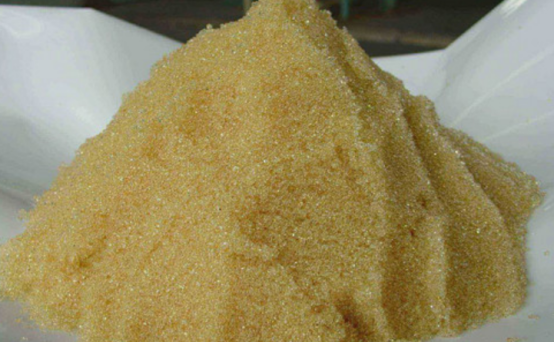
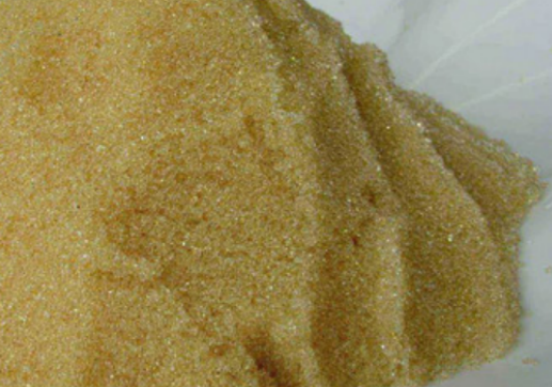
Cation Exchange Resin
Ion exchange is the reversible exchange of ions between a liquid and a solid, during the course of which the solid does not undergo any substantial changes. When this technique is applied to wine, the solid is an insoluble, permeable synthetic resin capable of exchanging ions with the wine with which it is in contact.
Cation-exchange resin
Formula: R−H acidic
The cation exchange method removes the hardness of water but induces acidity in it, which is further removed in the next stage of treatment of water by passing this acidic water through an anion exchange process.[6]
Reaction:
R−H + M+ = R−M + H+.
Similar to anion resins, in cation resins the regeneration involves the use of a strongly acidic solution, e.g. aqueous hydrochloric acid. During regeneration, the regenerant chemical passes through the resin and flushes out the trapped positive ions, renewing the resin exchange capacity.
Strong acid cation resins
Strong acid cation (SAC) exchange resins are among the most widely used resins, especially for softening applications, as they are effective at complete removal of hardness ions such as magnesium (Mg+) or calcium (Ca2+). Certain varieties of SAC resins have also been developed for applications demanding removal of barium and radium from drinking water or other streams. SAC resins can be damaged by oxidants and fouled by iron or manganese, so care must be taken to avoid exposure of the resin to these materials.
Weak acid cation resins
Weak acid cation (WAC) exchange resins remove cations associated with alkalinity (temporary hardness) and are used for demineralization and dealkalization applications. Additionally, WAC resins tend to have relatively high oxidation resistance and mechanical durability, making them a good choice for streams containing oxidants such as hydrogen peroxide and chlorine.